
Why it works
The evidence, not the sales pitch
Builders have heard plenty of claims about safety products. So rather than make our own, we commissioned an independent assessment, partnered with CHASNZ on ergonomics research, and had the product destruction-tested by an independent laboratory. Here is what all of it found.
Where a working platform sits in the hierarchy of controls
The hierarchy of controls sets the order in which a fall risk has to be managed: avoid the work at height, then prevent the fall, then limit its consequences, and only then rely on what an individual wears.
WorkSafe sets out the same order: eliminate the risk where you can; if you can't, use substitution or engineering controls, then administrative controls, with PPE as “the last line of defence”. (Source: WorkSafe, Working at height in New Zealand.)
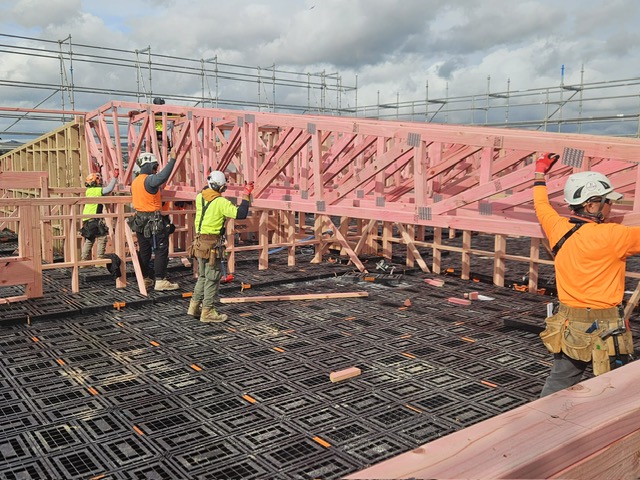
A working platform sits at the fall prevention step. The crew works from a continuous floor instead of above an open drop, so the fall is prevented rather than arrested. Safety nets sit at the next step: WorkSafe describes them as collective fall arrest systems, which limit the consequences if someone does fall. (Source: WorkSafe, Safe use of safety nets.) Both are collective protection: they protect everyone working above them without relying on what each person wears.
How nets and working platforms compare on site is covered on our safety nets page.
Sources: WorkSafe, Working at height in New Zealand; WorkSafe, Safe use of safety nets
What an independent assessment found
Workdek commissioned DSC Consulting, an independent quantity surveyor, to review five New Zealand projects. On every one, the tasks that depend on fall protection took fewer man-hours and fewer days with Workdek than with safety nets.
| On a 175m² single storey | Safety nets | Workdek |
|---|---|---|
| Duration of the tasks that depend on fall protection | 11 days | 6 days |
| Man-hours for those tasks | 176 hours | 96 hours |
Tested across five projects
| Project | Man-hours with nets | Man-hours with Workdek | Reduction |
|---|---|---|---|
| 185m² single storey | 120 | 72 | 40% |
| 2 × 160m² duplex | 192 | 120 | 37.5% |
| 175m² single storey | 176 | 96 | 45% |
| 385m² single storey | 384 | 288 | 25% |
| 2,272m² multi-unit | 3,000 | 2,000 | 33% |
- DSC Consulting independent quantitative assessment
Independent assessment of Workdek across five real New Zealand projects, reported as task duration and man-hours.
PDF · 247 KB
The Ergonomic Research: What and How
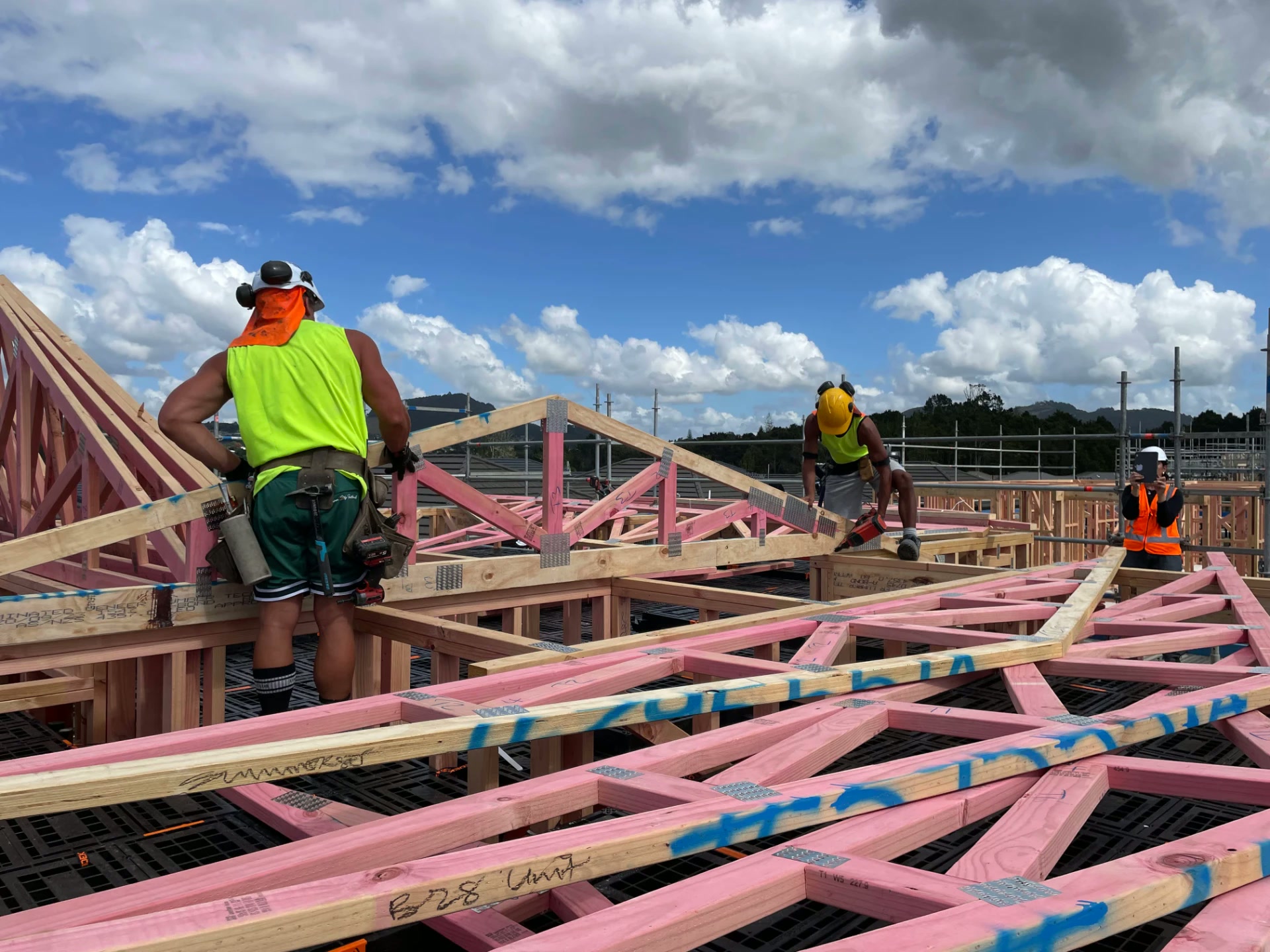
Workdek partnered with CHASNZ — the Construction Health and Safety New Zealand charity — on a March 2024 study at Summerset’s Whangārei construction site. A certified New Zealand ergonomist assessed photographs, video and on-site observations of two builders’ posture and working position, comparing the platform with a simulated net environment. The assessment was independently peer reviewed, and each builder was interviewed after working on the platform for half a day.


Ergonomics: what the research found
- Improved posture. Working from a stable internal platform put crews in better working positions than working from ladders, staging or structural members.
- Reduced back strain. Less bracing, less twisting, less reaching from an unstable base.
- Lower reported fatigue. Participants reported being less worn out across a working day.
- Greater confidence at height. Crews reported feeling more secure, which shows up directly in how quickly and how well people work.
“You don’t need to think about your foot position, or your hand holds — it’s heaps easier.” — Builder, Summerset, Whangārei
Why are these results important?
Falls are the risk everyone talks about. The slower damage is the one that accumulates — the back that goes at forty-five, the shoulder that never quite comes right, the apprentice who learns to work in a bad position because that is the only position available.
A working platform is not only about preventing the fall. It is about ensuring builders are able to enjoy a long working career, free of unnecessary pain.
- Safety platform research paper (April 2024)
Research paper covering working at height platforms and their use on New Zealand residential sites.
PDF · 953 KB
Independent destruction testing
Workdek commissioned Materials & Testing Laboratories Ltd, an independent Auckland industrial research company, to test the system to destruction.
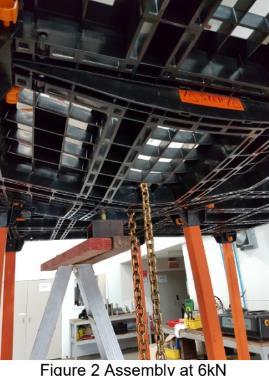
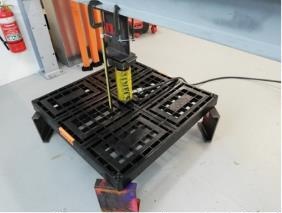
Pull-down test: a three-by-three platform tower was assembled unsupported and loaded at its midpoint using a 50 × 50mm load spreader, with load applied gradually until failure, using a 200kN hydraulic ram. The test reached the maximum stroke of the ram at a maximum load of 6kN. At that load there was 75mm of deflection at the central point, and the tower remained intact and structurally robust.
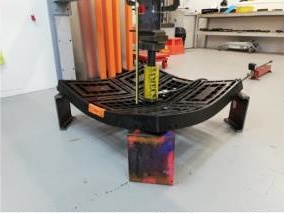
Panel test: a single platform supported at four corners was loaded at its midpoint. At 2kN there was 10mm of deflection. At 8kN there was 65mm of deflection, with some lateral buckling of the grills.
Tell us about your build.
Send us your plans and some details of the build, and one of the team will come back to you with a quote.